To Protein, or Not to Protein?
May 20, 2026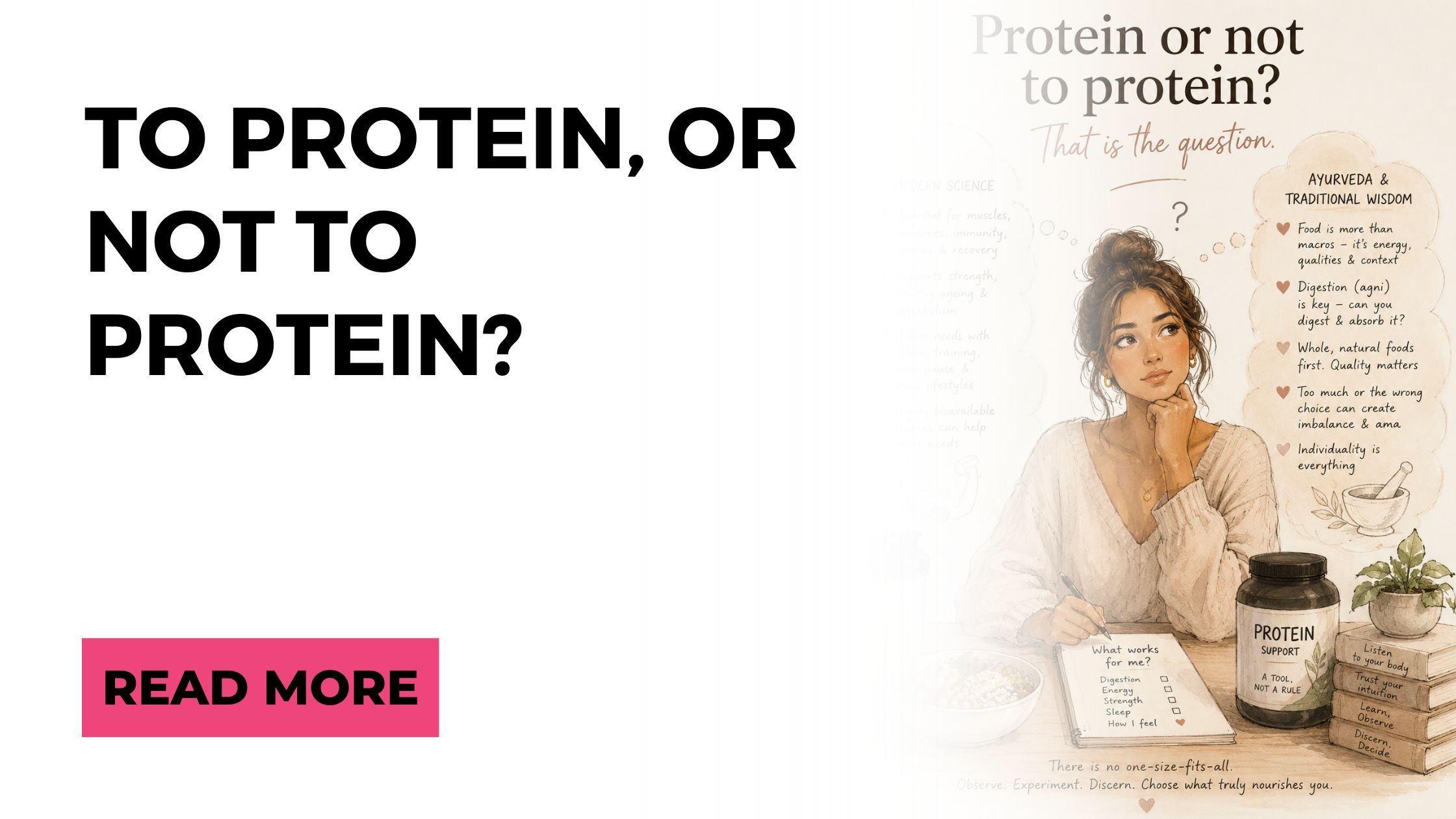
Protein has become one of the most polarising conversations in wellness culture.
On one side, modern nutrition culture can feel completely protein-obsessed.
Everything is becoming “high protein.”
Protein water.
Protein chocolate.
Protein cereal.
Protein bars masquerading as health food.
Fitness influencers telling women they need enormous amounts of protein while simultaneously selling powders, supplements, and affiliate links.
It’s understandable why people are pushing back and starting to think critically about how much protein we actually need to consume.
Is protein just another wellness trend, or is it something modern women genuinely need to pay more attention to?
This article explores the role of protein through both modern nutrition and Ayurvedic understanding, unpacking what protein actually does in the body, why our needs may be changing, and how to navigate the conversation without falling into extremes.
Nutrition has become overly reductionist in many spaces. Health gets flattened into numbers, macros, tracking apps, and optimisation culture, while people simultaneously ignore agni (digestive capacity), stress levels, and the actual quality of their lives.
And Ayurveda raises some very valid critiques of that.
Ayurveda reminds us that health is not just about what you consume.
It’s about what you digest.
What you absorb.
What your tissues can actually use.
And whether your lifestyle supports genuine nourishment in the first place.
But before we even argue about protein consumption, it’s worth understanding what protein is.
From a modern physiological perspective, protein is one of the fundamental building materials of the human body. Proteins are made up of amino acids - molecules used to build, repair, maintain, and regulate tissues throughout the body.
They are involved in:
- muscle repair and growth
- hormones and neurotransmitters
- immune function
- enzymes and metabolism
- blood sugar regulation
- hair, skin, and nails
- connective tissue and collagen formation
- satiety and energy regulation
- healthy ageing and tissue maintenance
In many ways, protein is part of the body’s structural and functional architecture.
We are constantly breaking down and rebuilding tissue. The body is dynamic, adaptive, and metabolically active, especially during stress, training, ageing, illness recovery, pregnancy, hormonal transitions, and periods of physical or emotional demand.
This is why modern science places so much emphasis on adequate protein intake.
And for women especially, emerging research around muscle mass, metabolic health, bone density, ageing, and hormonal resilience is increasingly important.
At the same time, Ayurveda approaches nourishment through an entirely different lens.
Ayurveda doesn’t describe “protein” in the modern biochemical sense because molecular biology didn’t exist at the time. Instead, Ayurveda observed the body through qualities, functions, tissue formation, vitality, digestion, and energetic effects.
Rather than isolating nutrients, Ayurveda focuses on the transformation of food into bodily tissues through agni: digestive and metabolic fire or capacity. Food is not simply “eaten.” It’s dependant on the body’s capacity to transform it.
Ayurveda describes seven primary tissues, or dhatus:
- rasa (plasma/fluids)
- rakta (blood)
- mamsa (muscle tissue)
- meda (fat tissue)
- asthi (bone)
- majja (nervous tissue/marrow)
- shukra/artava (reproductive and regenerative tissue)
From this perspective, foods that are deeply nourishing, strengthening, anabolic, and tissue-building would support the formation of mamsa dhatu and the subsequent nourishment of deeper tissues. So while Ayurveda may not use the word “protein,” it does recognise the importance of building and maintaining healthy tissue.
The language is different.
The framework is different.
But the body being observed is the same human body.
And this is where I think the conversation becomes much more interesting.
Because modern science explains what the body physically requires.
Ayurveda explores how nourishment is received, processed, and integrated.
Modern science says: The body requires amino acids for tissue maintenance and repair.
Ayurveda asks: Can your digestion actually transform food into healthy tissue?
Modern nutrition measures intake.
Ayurveda assesses assimilation.
Modern science studies muscle protein synthesis.
Ayurveda studies tissue nourishment, vitality, resilience, and the consequences of impaired digestion.
These are not opposing ideas. They are complementary perspectives. And modern women probably need both.
Because many women today are experiencing one or some of the below (bonus points if you tick all the boxes 😛):
- chronically stressed
- under-muscled
- sedentary
- hormonally depleted
- inflamed
- sleep deprived
- overworked
- peri-menopausal
- struggling to eat enough quality food consistently
In these contexts, adequate protein does genuinely matter.
Muscle mass matters.
Bone density matters.
Recovery matters.
Metabolic health matters.
Healthy ageing matters.
And yes, many women are likely under-consuming protein relative to what would actually support strength, resilience, and long-term health.
At the same time, Ayurveda contributes something incredibly important to the conversation:
More is not always better.
A person can hit every protein target on paper and still feel bloated, foggy, inflamed, exhausted, and unwell if their digestion is struggling, stress is chronic, meals are rushed, and their nervous system is constantly dysregulated.
That doesn’t mean protein is suddenly “bad.”
It means human health is more complex than macros alone.
And this is where the whey protein conversation gets interesting.
Some Ayurvedic practitioners strongly discourage isolated whey protein, arguing that it is overly processed, disconnected from its whole-food source, difficult to digest, or likely to create ama (poorly processed metabolic residue).
I can understand the philosophical reasoning behind that perspective.
Ayurveda traditionally favours fresh, whole, minimally processed foods prepared consciously and eaten in a regulated lifestyle context.
Which is completely reasonable.
But I also think it’s important not to turn philosophical frameworks into exaggerated biomedical claims.
Because in reality, many people do extremely well with whey isolate.
Athletes.
Busy mothers.
Vegetarians.
Women trying to build strength.
People recovering from illness.
Ageing populations with increased protein needs.
Clients who struggle to consistently prepare high-protein meals.
For many people, whey isolate is not a toxic burden on the body. It’s simply a practical nutritional tool, and often a very effective one.
Especially considering whey is highly bioavailable and rich in leucine, the amino acid strongly associated with muscle protein synthesis and recovery.
Does that mean everyone should consume it? No.
Some people genuinely do not tolerate it well. Some experience bloating, congestion, digestive discomfort, skin issues, or general heaviness.
But Ayurveda itself is supposed to be individualised.
It asks: What suits this person, in this season, at this age, with this digestion, under these life conditions?
That’s a much more intelligent conversation than universal declarations that something is inherently harmful for everyone.
The best way to approach it is with discernment:
You know your body.
You know your lifestyle.
You know your energy, digestion, recovery, and practical reality.
Observe.
Experiment.
Pay attention.
If adding protein powder leaves you feeling worse, bloated, sluggish, or inflamed, listen to that.
If it helps you consistently nourish yourself, recover better, feel stronger, stabilise energy, support training, and meet your nutritional needs realistically, listen to that too.
We do not need to demonise every modern nutritional tool simply because it didn’t exist 3000 years ago.
Nor should we blindly worship every wellness trend because it’s popular online.
And perhaps most importantly: context matters.
So, if we move away from extremes, neither blindly worshipping protein trends nor demonising modern nutritional tools, the next question becomes:
What does a genuinely nourishing, protein-conscious diet actually look like from a holistic perspective?
Because this conversation is not really about whether women should survive on protein shakes… nor whether all modern protein sources are toxic.
It’s about understanding how to adequately nourish the body in a way that supports strength, vitality, digestion, hormones, and long-term wellbeing.
And interestingly, a truly nourishing sattvic diet may be far more protein-rich than many people might imagine.
The body still requires raw materials to build:
- muscle tissue
- hormones
- neurotransmitters
- enzymes
- connective tissue
- healthy hair, skin, and nails
- bone tissue
- reproductive health
- resilience and vitality
Ayurveda may not describe this through amino acids and protein synthesis pathways, but it absolutely recognises the importance of building healthy tissue.
In Ayurveda, deeply nourishing foods help support the formation of the dhatus, the body’s tissues, particularly mamsa dhatu (muscle tissue) and the deeper reserves associated with strength, immunity, stability, and vitality.
And interestingly, many traditional sattvic foods are actually quite nourishing and protein supportive.
Things like:
- mung dal
- lentils
- kitchari combinations
- dairy if tolerated
- paneer
- yoghurt
- milk preparations
- nuts and seeds
- soaked almonds
- sesame
- tofu and tempeh
- quinoa
- warming stews and cooked meals with digestive spices
Ayurveda often combines foods strategically to support digestibility and assimilation, not just nutritional intake.
Because the question is never only:
“What contains protein?”
The question is also:
“Can the body comfortably digest, absorb, and utilise this nourishment?”
That’s an important distinction.
A sattvic diet is not meant to be restrictive, weak, or chronically depleting.
It’s meant to support clarity, steadiness, vitality, and balanced nourishment.
The body needs nourishment.
Which brings us back to the whey protein conversation.
Ideally, supplements supplement.
For some people, a well-structured whole-food diet may provide everything they need.
For others, particularly busy women, vegetarians, athletes, ageing populations, women in recovery, or those struggling to consistently meet higher protein needs, whey protein may simply be a practical and supportive addition.
Not the foundation of health.
Not inherently toxic.
Not mandatory for everyone either.
Just one tool within a much broader picture of nourishment, lifestyle, digestion, and individuality.
And perhaps that’s the most balanced perspective of all: less ideology, more observation.
Pay attention to your body.
Pay attention to your digestion.
Pay attention to your strength, recovery, energy, mood, and resilience.
Observe.
Experiment.
Discern.
And choose the approach that genuinely nourishes you.